
You finished the bake, the loaf is cooling on the rack, and then you turn around and see it: the mixing bowl, crusted with a ring of dough that's set like cement. If you bake sourdough at home, you know this isn't a quick rinse job. Left for an hour, raw dough turns into a stubborn, papery skin that laughs at your sponge.
Here's how to get it off fast — and why the way most of us do it (a long soak and a lot of scrubbing) is the slowest option going.
Why dried dough is such a nightmare to clean
Dough sticks for a reason. When flour meets water, two proteins — glutenin and gliadin — link up into gluten, a stretchy, elastic network. That's exactly what gives bread its chew. It's also what makes the residue cling to your bowl. As the dough dries, the starch sets and the gluten tightens, gripping onto every scratch and pore in the surface.
So when you scrub, you're not really cleaning — you're fighting chemistry. The fix is to break the dough down rather than muscle it off.
The methods, ranked from slowest to smartest
The overnight soak (what most people do)
Fill the bowl with warm water, leave it on the bench overnight, scrub in the morning. It works, eventually, but it ties up your bowl for hours and you'll still be scraping the next day. Fine in a pinch. A faff if you bake often.
Warm water and a dough scraper (the quick manual method)
This is the fastest no-product approach, and it's worth knowing:
- Let the bowl cool to room temperature first. Don't blast dried dough with boiling water — heat can cook the gluten and set the residue harder, not softer.
- Add a few centimetres of warm (not hot) water and let it sit for 10–15 minutes. The water hydrates the dough and loosens its grip.
- Use a plastic dough scraper or bench scraper — not a metal knife — to lift the softened dough off in sheets. Work from the edges in.
- Tip the loosened bits into the bin (never the drain — dough swells and clogs pipes), then wash as normal.
For the stand mixer, the same logic applies to the bowl and the dough hook. Soak, then scrape the hook with the edge of the scraper to clear the crusted ring around the shaft.
An enzyme-based cleaner (the smart method)
This is where you stop scrubbing altogether. Enzymes are biological tools that target specific molecules — and there are enzymes that break down both starch (amylase) and the proteins in gluten (protease). Use a cleaner built around them and the dough essentially digests itself off the surface.
That's the idea behind Dissolve My Dough: a food-grade enzyme blend that breaks down the starch and gluten so the dough lifts away on its own. You pump a little into the bowl, walk off and let the loaf cool, come back and rinse. No soaking overnight, no scraping, and it's gentle enough for everyday use on well-worn baker's hands. It's the difference between removing dough and dissolving it.
What not to do
- Don't use boiling water on raw dried dough. It can set the gluten and make the mess worse.
- Don't reach for a metal scourer on coated, ceramic, or anodised mixer bowls — you'll scratch the surface and give future dough even more to grip onto.
- Don't wash your banneton (proving basket) with soap or hot water. Rattan and cane bannetons are cleaned dry — brush out the flour with a stiff brush and let it air. Soaking ruins the basket and strips the flour seasoning that stops your dough sticking in the first place.
- Don't tip dough down the sink. It swells with water and is a classic cause of blocked drains. Bin it.
Frequently asked questions
How do you get dried dough off a bowl quickly?
Let the bowl cool, add warm (not hot) water for 10–15 minutes to soften the dough, then lift it off with a plastic dough scraper. An enzyme-based dough cleaner removes the need to scrape at all — it breaks the dough down so it rinses away.
Why does dough stick to everything so badly?
Because flour and water form gluten, a stretchy protein network that grips onto surfaces and only tightens as it dries. You have to break it down chemically rather than scrub it off.
Can I use hot water to clean dried dough?
Use warm water, not boiling. Very hot water can cook the gluten and set the residue harder, making it more difficult to remove.
Is it safe to put dough down the drain?
No. Dough swells when it absorbs water and is a common cause of blocked pipes. Always scrape it into the bin.
How do you clean a sourdough mixing bowl without scrubbing?
Either soak in warm water to soften, or use a food-grade enzyme cleaner that dissolves the starch and gluten so the dough lifts off on its own.
Bake more, scrub less. Dissolve My Dough is a gentle, plant-based enzyme cleaner made in Melbourne for bakers who'd rather be proving the next loaf than scraping the last one.
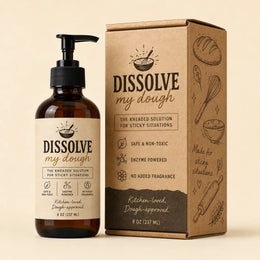
Dough Dissolve
A plant-based enzyme cleaner that dissolves dried dough so you can stop scrubbing.
Bake more. Scrub less.
Dough Dissolve is the plant-based enzyme cleaner built for sticky dough. Skip the overnight soak — let the formula do the work.
Try Dough Dissolve